AI SEARCH
Why Greek Businesses Are Invisible on ChatGPT (And How to Fix It in a Week)
Open ChatGPT. Type: "best boutique hotel in Glyfada". The answer comes back in three seconds. It names three places. None of them are yours.
This is happening every day, to thousands of Greek businesses, and most owners don't even know it. The traffic that used to come from Google is increasingly going through AI assistants — ChatGPT, Perplexity, Claude, Gemini — and Greek businesses, almost without exception, are invisible there.
This article explains why, and what specifically to do about it.

Google rewards keywords. AI rewards structure.
For 20 years, "ranking on Google" meant putting the right words on the page. Title tags, meta descriptions, keyword density — Greek SEO agencies built entire businesses around this stack, and most of the websites they shipped between 2014 and 2022 still reflect it.
AI search works differently. ChatGPT doesn't index your page and rank it against a query. It reads pages, builds an internal model of what your business actually is, and then references that model when someone asks a related question. To do that well, it needs three things:
- Semantic structure — clear headings, real paragraphs, FAQ blocks, an "about" that actually says what you do.
- Schema markup — machine-readable JSON-LD that says "this is a hotel," "this is the address," "these are the hours," "these are the reviews."
- Real, specific copy — not "we offer premium services in a beautiful setting" but "we have 12 sea-view rooms in Glyfada, two suites with private pools, a restaurant on the rooftop that opens at 7pm."
Almost no Greek business website hits all three. Many hit none of them.
The real reason most Greek sites fail
Three things compound:
The site is in Greek only. AI training data, even today in 2026, is predominantly English. A purely Greek site is harder for AI to understand and harder for it to confidently recommend. A bilingual site, where every section exists in both languages on the same URLs, doubles your AI surface area.
The schema is missing. Most Greek business sites have zero structured data. No LocalBusiness, no FAQPage, no Product, no Review. To an AI crawler, these sites are pretty pictures and decorative text.
The copy is decorative. Greek business sites tend to lean on poetry: "Discover the magic of authentic Greek hospitality." That sentence helps an AI assistant zero. AI needs facts: where, what, how much, when, for whom, with what reviews.
What "AI-optimized" actually looks like
An AI-friendly site reads, on the surface, like any clean modern website. The difference is what's beneath.
Take a real example: a 14-room boutique hotel in Athens. The old site has a homepage, a "rooms" page with photos, and a contact form. Total content: about 400 words.
The AI-optimized version has the same visual layout but:
- A structured
LocalBusinessschema with address, opening hours, accepted payment methods, languages spoken. - A FAQ section with 12 real questions guests have actually asked: "Can we leave luggage after checkout?", "Is there parking?", "What time is breakfast?".
- Each room has a
HotelRoomschema with size, view, max occupancy, in-room amenities, base price. - The "about" section names specific neighbourhoods, walking times to landmarks, what kind of traveler the hotel suits.
- Real reviews — pulled from Booking and Google — embedded with
Reviewschema.
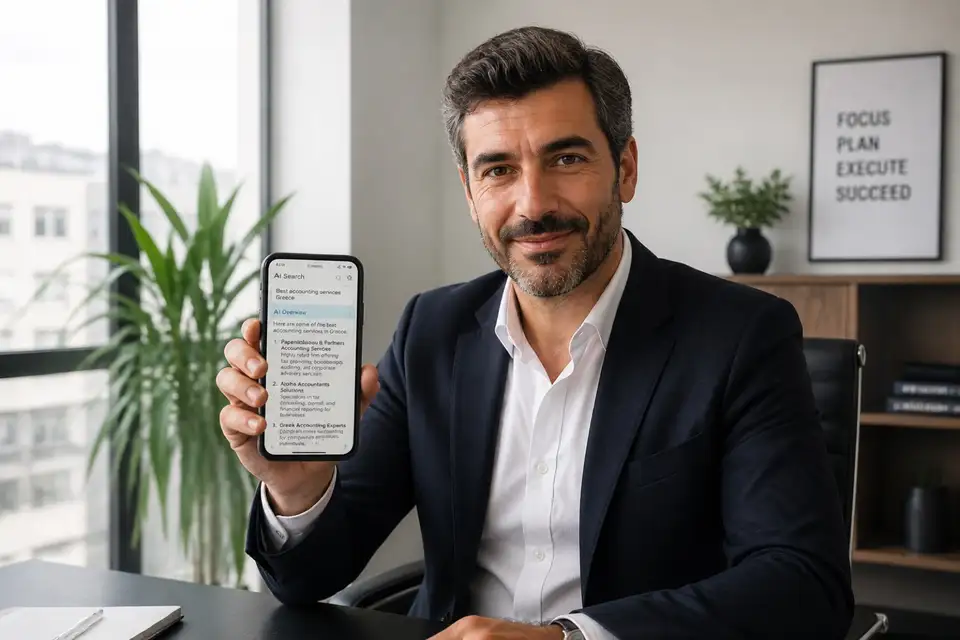
A week after launch, that hotel started appearing in ChatGPT answers to "boutique hotels near the Acropolis," "small hotels in Athens with rooftop," "where to stay in Athens for a couple."
Why this is fixable in a week
The work isn't hard — it's just specific. Most Greek agencies don't do it because their sales pitch is "design," not "structure." The tooling is mature: Astro renders this stuff statically, schema generators handle the JSON-LD, AI itself can help draft the FAQ.
From scratch, a properly structured AI-optimized site for a small Greek business takes 2–5 days of focused work. A straightforward one takes two: a day to capture the content and build, a day to launch and submit. A larger one — more pages, both languages, richer schema — takes five: a day for content, three to build, one to launch and submit. Either way, by day 7 AI assistants start referencing it.
The cost of waiting
Here's the part most owners underestimate: this isn't a curiosity. By the end of 2026, it's our estimate that 50%+ of all "where should I X" decisions in Greek tourism, hospitality, dining, services, real estate, and retail will start in an AI assistant. Greece's English-speaking visitor traffic — the segment with the highest spend per head — is already there.
Every month a business stays invisible is a month its competitors get a referral instead. The fix isn't expensive or slow. The cost is mostly attention.